Installing a whole-house backup power system requires balancing generator or battery capacity against panel wiring, transfer switch logic, and utility supply infrastructure. Skimping on preliminary load audits or installation engineering frequently causes nuisance overload tripping, voided equipment warranties, and expensive electrical retrofits.
A complete whole-house backup power system costs between $6,000 and $25,000+ fully installed. Standby air-cooled generators range from $6,000 to $13,000, whole-home battery storage systems run $12,000 to $28,000, and high-capacity liquid-cooled or hybrid setups span $20,000 to $45,000+. Hardware accounts for roughly 45–50% of the total budget, while professional electrical, plumbing, and permitting labor make up the remainder.
Immediate System & Financial Safety Status
Before committing to a backup power installation, verify these critical physical and electrical prerequisites to avoid unexpected budget overruns:
- Main Electrical Service Rating: Audit your panel busbar capacity (100A, 200A, or 400A) to confirm whether a service panel upgrade is mandatory before adding backup feeds.
- Fuel Supply & Gas Meter Delivery: Check your natural gas meter capacity (measured in cubic feet per hour, or CFH) or liquid propane tank volume to ensure it can supply the required BTU/hr under full engine load.
- Transfer Switch Amperage Sizing: The automatic transfer switch (ATS) rating must match or exceed your main disconnect breaker rating (e.g., a 200A main service requires a 200A service-entrance-rated ATS).
- NFPA 37 Setback Clearances: Standby generators require a minimum 5-foot clearance from windows, doors, soffit vents, and combustible walls to pass municipal building inspections.
- Unpermitted Hookup Hazards: Avoid temporary backfeed arrangements or manual interlock improvisations that violate local code, risk utility worker safety, and void homeowner insurance policies.
System Cost Branching: Low vs. High Investment Paths
System cost depends on home square footage, electrical demand, and the underlying backup technology selected:
[Determine Backup Power Strategy]
  │
  ├── Partial / Essential Loads ($1,500 – $4,000)
  │     └── Portable Generator (8kW–12kW) + Manual Transfer Switch / Interlock
  │
  ├── Whole-Home Air-Cooled Standby ($6,000 – $13,000)
  │     └── Gas Standby Generator (14kW–26kW) + 200A Automatic Transfer Switch
  │
  ├── Whole-Home Energy Storage ($12,000 – $28,000)
  │     └── Lithium Iron Phosphate Battery (10kWh–30kWh) + Hybrid Inverter + Smart Load Panel
  │
  └── Estate / Commercial Hybrid ($20,000 – $45,000+)
        └── Liquid-Cooled Generator (25kW–150kW) or Stacked Battery-Generator Microgrid
- Essential-Circuit Portable System ($1,500 – $4,000): Manual transfer switch + 8kW–12kW portable generator. Powers critical refrigeration, well pumps, and lighting circuits.
- Air-Cooled Whole-Home Standby ($6,000 – $13,000): Automatic transfer switch + 14kW–26kW gas-fueled standby unit. Covers standard single-family homes (up to 2,500 sq ft) with automatic cutover.
- Whole-Home Battery Storage ($12,000 – $28,000): Smart load panel + 10kWh–30kWh lithium iron phosphate (LFP) batteries + hybrid inverter. Provides silent, zero-emissions backup for essential and heavy household loads.
- Liquid-Cooled / Hybrid Microgrid ($20,000 – $45,000+): Commercial-grade 25kW–150kW liquid-cooled generator or stacked solar-battery-generator system for large estates (3,500+ sq ft) or homes with high inductive motor loads (multiple central AC units).
System Analysis (The “Why”)
A complete backup power installation consists of four distinct engineering components. The total turnkey cost reflects not just the power generation unit, but the integration hardware required to isolate your home from the utility grid automatically.
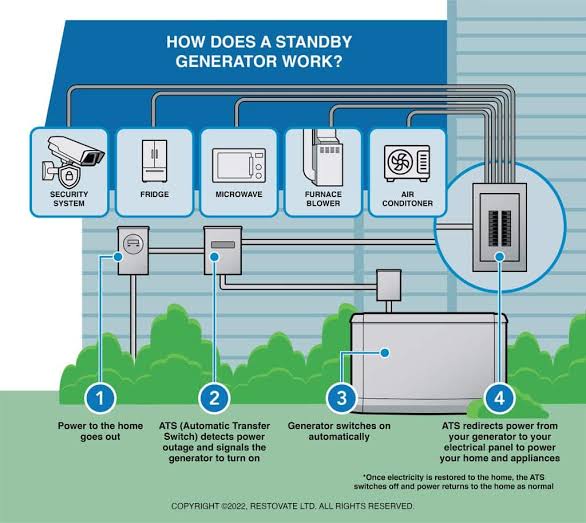
System Architecture: Whole-House Standby Generator Integration. Source: Mike Holmes
- Power Generation or Storage Unit (45–50% of Budget): The engine-generator set (stator/rotor end) or battery energy storage system (BESS) with integrated inverter controls.
- Transfer Logic & Service Disconnect (15–20% of Budget): An automatic transfer switch (ATS) detects utility voltage loss, signals the generator to start, and transfers the building load via mechanical contactors once frequency and voltage stabilize.
- Electrical Infrastructure & Panel Integration (15–20% of Budget): Heavy-gauge copper conductors, subpanels, load-shedding modules, and grounding/bonding connections necessary to interface with your home distribution panel safely.
- Utility Connections & Site Infrastructure (10–15% of Budget): Poured concrete or composite mounting pads, gas pipe sizing upgrades, trenching, and municipal permit approvals.
The Most Likely Culprit: Cost Distribution Breakdown
When homeowners receive high installation quotes, the extra expense rarely comes from inflated equipment markup. Instead, site-specific electrical and mechanical upgrades drive up total project costs.
| Cost Category | Percentage of Total Investment | Typical Range | Primary Cost Drivers |
|---|---|---|---|
| Primary Equipment | 45% – 50% | $3,000 – $14,000 | Generator output wattage (kW), battery storage capacity (kWh), inverter surge rating. |
| Electrical & Plumbing Labor | 30% – 35% | $2,000 – $7,000 | Master electrician rates, pipefitting for gas lines, main panel tie-ins, ATS mounting. |
| Site Prep & Infrastructure | 10% – 15% | $800 – $2,500 | Concrete slab installation, ground trenching, gas meter regulator upgrades. |
| Permits & Utility Fees | 5% – 10% | $300 – $1,200 | Municipal building permits, electrical plan reviews, utility disconnect/reconnect fees. |
The Cost of Delay: Under-Sizing or Skimping on Installation
Cutting corners on initial capacity or skipping required electrical upgrades creates progressive operational failures during major outages:
- Immediate (Hour 1 of Outage): An undersized generator bogs down or stalls when central AC compressors cycle on due to excessive locked rotor amperage (LRA).
- Short-Term (24–48 Hours): High Total Harmonic Distortion (THD) from unconditioned portable generator output overheats sensitive appliance control boards, leading to inverter board failures in refrigerators and HVAC units.
- Long-Term (1–5 Years): Gas supply starvation forces engine lean-burn conditions, burning exhaust valves; improper neutral-ground bonding causes hidden ground-loop corrosion; unpermitted installations result in denied insurance claims following storm damage.
For detailed hardware installation pricing, see Project Estimates: Breakdown of Generator Installation Costs.
System Cost Differentiators
Choosing between gas standby generators, liquid-cooled engines, and lithium battery storage involves key tradeoffs in upfront cost, fuel availability, and maintenance:
Air-Cooled Gas Standby Generators (14kW – 26kW)
- Upfront Hardware Cost: $4,000 – $7,000
- Total Installed Cost: $6,000 – $13,000
- Operational Characteristics: Runs on natural gas or propane. High-speed 3,600 RPM engine. Ideal for standard residential loads. Requires regular oil changes and valve adjustments every 100–200 operating hours.
Liquid-Cooled Heavy-Duty Generators (25kW – 150kW)
- Upfront Hardware Cost: $10,000 – $25,000+
- Total Installed Cost: $15,000 – $35,000+
- Operational Characteristics: Low-speed 1,800 RPM automotive engine design. Extremely quiet, long lifespan (20+ years), capable of powering large luxury estates, medical equipment, or high inductive motor loads without voltage sag.
Lithium Battery Storage Systems (10kWh – 30kWh)
- Upfront Hardware Cost: $8,000 – $18,000
- Total Installed Cost: $12,000 – $28,000
- Operational Characteristics: Silent operation with zero direct emissions. Provides sub-second automatic transfer times. Best paired with solar PV array for extended multi-day outages. Higher initial capital cost per kWh compared to gas units, but requires zero engine maintenance.
For a deeper look into battery pricing models, consult Energy Storage Pricing: Home Battery Backup System Costs Guide.
The “Right Now” Protocol
Follow this pre-investment evaluation checklist before requesting contractor bids:
- Perform a Full Load Calculation: Add up continuous running watts and starting surge watts (Locked Rotor Amps) for all major motor-driven appliances (central AC, heat pumps, well pumps).
- Audit Your Gas Meter & Supply Piping: Verify that your natural gas meter delivers sufficient pressure (3.5 to 7 inches water column) and volumetric flow (250,000 to 400,000 BTU/hr) under peak load.
- Inspect Main Electrical Panel Busbars: Check if your main panel has space for a double-pole feeder breaker or if a service-entrance-rated ATS must be installed upstream of the main panel.
- Verify Municipal Setback Restrictions: Measure distances from property lines, window wells, and air intakes to ensure compliance with NFPA 37 before ordering equipment.
WARNING: CRITICAL SAFETY HARD-STOPS
- NEVER connect a backup generator or battery output directly to a panel without an approved mechanical interlock or UL-listed transfer switch. Backfeeding energizes utility lines, creating lethal hazards for line repair crews.
- NEVER operate a standby generator on an undersized gas line (under 3/4-inch or 1-inch ID depending on run length). Fuel starvation causes engine hunting, severe voltage drop, and lean-burn engine failure.
- NEVER bypass local electrical permitting. Unpermitted electrical modifications void homeowner insurance policies in the event of an electrical fire or equipment burnout.
The Professional Inspection Path
During a site audit, a licensed electrician or system integrator uses specialized diagnostic tools to determine exact installation costs:
- Digital Clamp Meter & Load Logger: Clamped around main service conductors to record real-time peak amp draw over 24 to 72 hours, preventing over-sizing or under-sizing of the generator.
- Gas Pressure Manometer: Connected to gas test ports to measure static and dynamic fuel line pressure drop during engine cranking and full step-load acceptance.
- Insulation Resistance Tester (Megger): Applies high-voltage DC to underground feeder wires to verify conductor insulation integrity before energizing subpanels or inlet boxes.
- Power Quality & THD Analyzer: Measures Total Harmonic Distortion under load to ensure clean power delivery (<5% THD) for sensitive electronics.
Estimated Comprehensive Cost Breakdown
The table below outlines real-world turnkey cost expectations across common residential system configurations:
| System Configuration | Equipment Cost | Labor & Materials | Permits & Site Prep | Total Installed Cost |
|---|---|---|---|---|
| Portable (10kW) + Manual Switch | $1,000 – $2,200 | $600 – $1,200 | $150 – $300 | $1,750 – $3,700 |
| Air-Cooled Standby (18kW – 22kW) | $4,500 – $6,500 | $2,500 – $4,500 | $500 – $1,000 | $7,500 – $12,000 |
| Large Air-Cooled Standby (24kW – 26kW) | $6,000 – $8,000 | $3,000 – $5,500 | $600 – $1,200 | $9,600 – $14,700 |
| Whole-Home Battery Storage (15kWh) | $9,000 – $13,000 | $3,000 – $5,000 | $500 – $1,000 | $12,500 – $19,000 |
| Liquid-Cooled Standby (30kW+) | $12,000 – $22,000 | $5,000 – $9,000 | $1,000 – $2,500 | $18,000 – $33,500 |
| Hybrid (Solar + Battery + Generator) | $18,000 – $32,000 | $7,000 – $12,000 | $1,200 – $2,500 | $26,200 – $46,500 |
Symptom Escalators & Related Investment Guides
If your budget evaluation requires specific electrical or architectural adjustments, reference these detailed cost guides:
- Infrastructure Costs: Electrical Panel Upgrade Costs for Backup: Evaluating panel replacement fees when adding backup transfer equipment.
- Combined System Pricing: Hybrid Backup Power System Costs: Cost breakdowns for integrated generator, solar, and battery microgrids.
- Financial Modeling: Backup Power ROI Calculations for Homeowners: Calculating property value additions, insurance rate offsets, and outage loss prevention ROI.
Final Circuit Check
Calculating the true cost of a whole-house backup power system requires auditing electrical service capacity, gas supply dynamics, and panel space before selecting hardware. Work with a licensed electrical contractor to perform a real-time load log and site survey, ensuring your investment delivers reliable, code-compliant emergency power when the grid fails.